

Case study – logistics
Digitization and traceability in logistics movements
This case study analyzes the RFID implementation for a leading logistics company in Southern Europe, which seeks to strengthen the control and efficiency of its operational processes. The company manages national and international transport, industrial logistics, parcel and pallet distribution, document management and ancillary logistics services, and has extensive facilities and a large fleet of vehicles.

Context and challenge
Analysis of the operational flow prior to the solution and its critical points.
After consolidating a large-scale logistics infrastructure, the client decides to implement a technology strategy to secure its operational processes, ensuring both efficiency and effectiveness.
During its activity, the company identified several points for improvement related to product traceability. This is where Myruns RFID technology comes into play.
Critical points to intervene
Logistics center

The assets to be mapped are tires, the initial use case being high value-added merchandise.
Transportation

Need for traceability and visibility with full coverage.
Logistics center
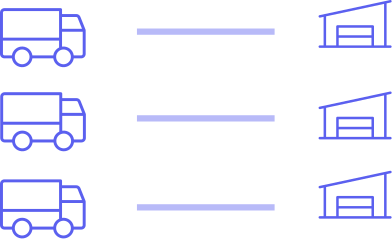
There is a clear lack of traceability, which generates conflicts between logistics centers and also with suppliers.
Myruns Solution
Complete implementation with RFID product and monitoring software
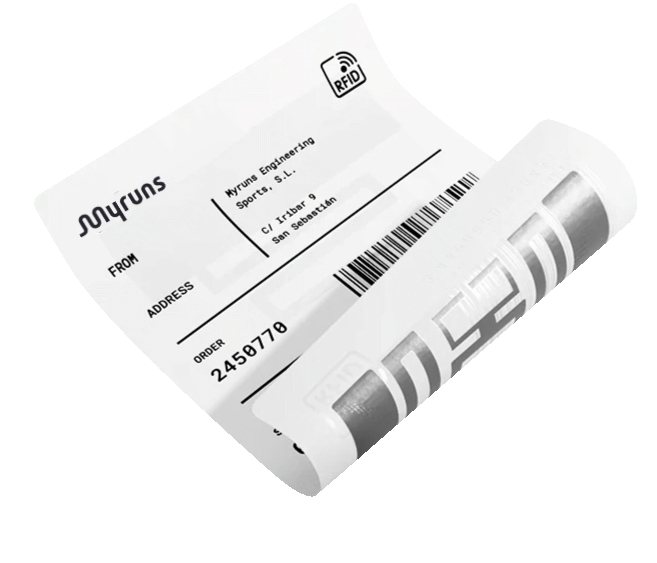

Tire labeling at source, choosing and adapting the RFID tag
Myruns team performs a consultancy regarding the asset to be labeled to evaluate which is the most appropriate label. An inlay that meets the reading requirements is selected and the final format of the label is defined with the client.
The customer validates the efficiency of the label along with the operability of the overall solution, which validates Myruns as their supplier to supply this label design in large quantities.
We installed a reading system for expeditions with reading processors and Myruns antennas.
We install an RFID reading system (reader + antennas) at the outbound logistics center of origin, where the warehouses with the customer’s merchandise (tires) are located. This is where the traceability process begins, with the first RFID control point.
At the customer’s logistics center, is where the next checkpoint is established, here the cargo will be distributed for shipment, from which the traceability of the assets is also extracted through the second RFID checkpoint. The destination of the goods are the distribution centers of the goods of the companies to which it supplies.
To implement the control points, products from the MYBUILD range were used , comprising Myruns brand components that make up an RFID reading system. These products were the MB A3 RFID antenna and the MB R1 RFID reader.
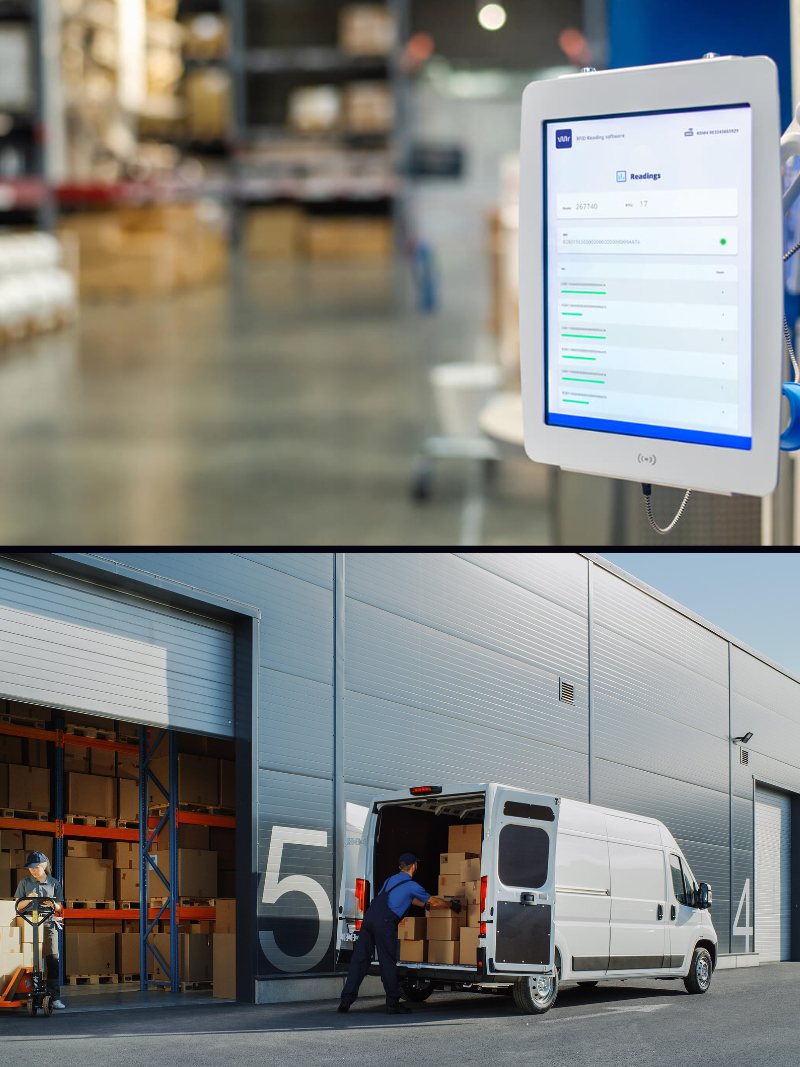

We implemented the operational monitoring software for Myruns devices connected to the installation.
Both the control point installed at the logistic center of origin and the one at the customer’s logistic center are connected to the RFID software platform MC Station. This software is designed to maintain the operational monitoring of Myruns products throughout the customer’s logistic-operational flow.
Results and benefits
Operational flow after implementing the solution
Better identification of goods in transit
An RFID source tagging procedure is implemented that will bring high added value to the entire supply chain.
Clear visibility of system operability
Myruns products are connected to the MC Station platform, which reports on the operability of the control structures.
Coordination between logistics centers
Control structures at key points in the transit of goods provide clear traceability from origin to destination.